Anti CD9 Antigen (MRP-1/Tspan-29) mAb (Clone 12A12)Cosmo BioPrice from $246.00 to $463.00.

No reviews have been added for this product.
Cosmo Bio

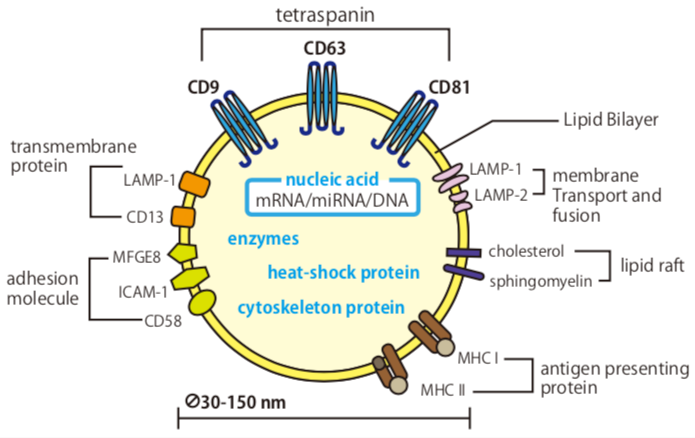
CD9 is a cell surface glycoprotein which belongs to the tetraspanin superfamily. CD9 is known to complex with integrins and other transmembrane 4 superfamily proteins. It can modulate cell adhesion and migration and also trigger platelet activation and aggregation. Importantly, it is found on the surface of exosomes.
Exosomes are cell-derived vesicles bounded by a lipid bilayer membrane and exhibiting a diameter of 50 to 150 nm. They are secreted from cultured cells and are observed in body fluids such as saliva, blood, urine, amniotic fluid, malignant ascites. Recent studies indicate that exosomes contain various proteins and RNAs, suggesting a role in information transfer between cells.
This monoclonal antibody can be used to immunoprecipitate exosomes from serum and culture supernatants.
| Product Specifications | |
| Application | FC |
| Reactivity | Human |
| Clonality | Monoclonal (Clone No.: 12A12) |
| Host | Mouse |
| Conjugation | Tide Fluor™ 2SW |
| Documents & Links for Anti CD9 Antigen (MRP-1/Tspan-29) mAb (Clone 12A12, TF2WS Labeled) | |
| Datasheet | Anti CD9 Antigen (MRP-1/Tspan-29) mAb (Clone 12A12, TF2WS Labeled) Datasheet |
| Documents & Links for Anti CD9 Antigen (MRP-1/Tspan-29) mAb (Clone 12A12, TF2WS Labeled) | |
| Datasheet | Anti CD9 Antigen (MRP-1/Tspan-29) mAb (Clone 12A12, TF2WS Labeled) Datasheet |
| Citations for Anti CD9 Antigen (MRP-1/Tspan-29) mAb (Clone 12A12, TF2WS Labeled) – 1 Found |
| Masaki, Kanako; Ahmed, Abo Bakr F; Ishida, Takenori; Mikami, Yuuki; Funabashi, Hisakage; Hirota, Ryuichi; Ikeda, Takeshi; Kuroda, Akio. Chromatographic purification of small extracellular vesicles using an affinity column for phospholipid membranes. Biotechnology Letters. 2023;45(11-12):1457-1466. PubMed |
Cosmo Bio
CD9 is a cell surface glycoprotein which belongs to the tetraspanin superfamily. CD9 is known to complex with integrins and other transmembrane 4 superfamily proteins. It can modulate cell adhesion and migration and also trigger platelet activation and aggregation. Importantly, it is found on the surface of exosomes.
Exosomes are cell-derived vesicles bounded by a lipid bilayer membrane and exhibiting a diameter of 50 to 150 nm. They are secreted from cultured cells and are observed in body fluids such as saliva, blood, urine, amniotic fluid, malignant ascites. Recent studies indicate that exosomes contain various proteins and RNAs, suggesting a role in information transfer between cells.
This monoclonal antibody can be used to immunoprecipitate exosomes from serum and culture supernatants.
| Product Specifications | |
| Application | FC |
| Reactivity | Human |
| Clonality | Monoclonal (Clone No.: 12A12) |
| Host | Mouse |
| Conjugation | Tide Fluor™ 2SW |
| Documents & Links for Anti CD9 Antigen (MRP-1/Tspan-29) mAb (Clone 12A12, TF2WS Labeled) | |
| Datasheet | Anti CD9 Antigen (MRP-1/Tspan-29) mAb (Clone 12A12, TF2WS Labeled) Datasheet |
| Documents & Links for Anti CD9 Antigen (MRP-1/Tspan-29) mAb (Clone 12A12, TF2WS Labeled) | |
| Datasheet | Anti CD9 Antigen (MRP-1/Tspan-29) mAb (Clone 12A12, TF2WS Labeled) Datasheet |
| Citations for Anti CD9 Antigen (MRP-1/Tspan-29) mAb (Clone 12A12, TF2WS Labeled) – 1 Found |
| Masaki, Kanako; Ahmed, Abo Bakr F; Ishida, Takenori; Mikami, Yuuki; Funabashi, Hisakage; Hirota, Ryuichi; Ikeda, Takeshi; Kuroda, Akio. Chromatographic purification of small extracellular vesicles using an affinity column for phospholipid membranes. Biotechnology Letters. 2023;45(11-12):1457-1466. PubMed |