Loading...
Loading...
Loading...
Loading...

Try browsing our complete catalog of products.
No reviews have been added for this product.
Cosmo Bio
Cosmo Bio
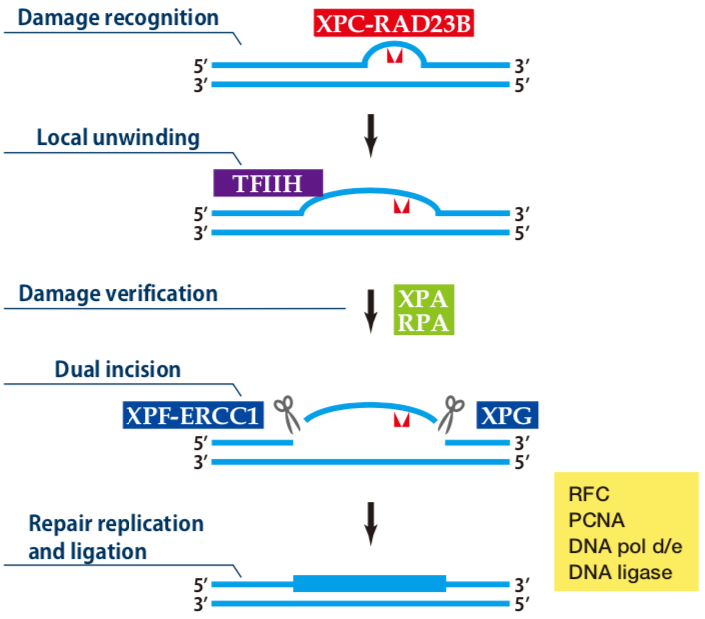

Nucleotide excision repair (NER) is a major repair system for removing a variety of DNA lesions including UV-induced cyclobutane pyrimidine dimers and (6-4) photoproducts as well as chemically-induced bulky base adducts. Defects in the NER system give rise to xeroderma pigmentosum (XP), an autosomal recessive disease characterized by a predisposition to skin cancer and in some cases neurological abnormalities. The early process of human NER, from damage recognition to dual incision (removal of damage-containing oligonucleotides), is accomplished by six core NER factors, XPC-RAD23B, TFIIH, XPA, RPA, XPF-ERCC1 and XPG.
XPF harbors a nuclease domain and forms a stable complex with ERCC1. The ERCC1-XPF complex has a unique ability to make a nick on the DNA strand which makes the transition from duplex to single-stranded DNA in the 5' to 3' direction. In the NER process, ERCC1-XPF is responsible for 5'-incision at a dual incision step.
| Product Specifications | |
| Application | IF, WB |
| Reactivity | Mouse, Human |
| Clonality | Monoclonal (Clone No.: 19-16) |
| Host | Mouse |
| Documents & Links for Anti DNA Repair Endonuclease XPF (XPF/ERCC4) mAb (Clone 19-16) | |
| Datasheet | Anti DNA Repair Endonuclease XPF (XPF/ERCC4) mAb (Clone 19-16) Datasheet |
| Documents & Links for Anti DNA Repair Endonuclease XPF (XPF/ERCC4) mAb (Clone 19-16) | |
| Datasheet | Anti DNA Repair Endonuclease XPF (XPF/ERCC4) mAb (Clone 19-16) Datasheet |
Nucleotide excision repair (NER) is a major repair system for removing a variety of DNA lesions including UV-induced cyclobutane pyrimidine dimers and (6-4) photoproducts as well as chemically-induced bulky base adducts. Defects in the NER system give rise to xeroderma pigmentosum (XP), an autosomal recessive disease characterized by a predisposition to skin cancer and in some cases neurological abnormalities. The early process of human NER, from damage recognition to dual incision (removal of damage-containing oligonucleotides), is accomplished by six core NER factors, XPC-RAD23B, TFIIH, XPA, RPA, XPF-ERCC1 and XPG.
XPF harbors a nuclease domain and forms a stable complex with ERCC1. The ERCC1-XPF complex has a unique ability to make a nick on the DNA strand which makes the transition from duplex to single-stranded DNA in the 5' to 3' direction. In the NER process, ERCC1-XPF is responsible for 5'-incision at a dual incision step.
| Product Specifications | |
| Application | IF, WB |
| Reactivity | Mouse, Human |
| Clonality | Monoclonal (Clone No.: 19-16) |
| Host | Mouse |
| Documents & Links for Anti DNA Repair Endonuclease XPF (XPF/ERCC4) mAb (Clone 19-16) | |
| Datasheet | Anti DNA Repair Endonuclease XPF (XPF/ERCC4) mAb (Clone 19-16) Datasheet |
| Documents & Links for Anti DNA Repair Endonuclease XPF (XPF/ERCC4) mAb (Clone 19-16) | |
| Datasheet | Anti DNA Repair Endonuclease XPF (XPF/ERCC4) mAb (Clone 19-16) Datasheet |